The Stablecoin Yield Gap: A $280B Problem
Why most stablecoin capital sits idle and why the fix is a routing layer, not another aggregator
There are roughly $323B USD in stablecoins onchain today. About $43.5B is actively deployed in DeFi earning yield on lending markets, liquidity pools, and vaults. The remaining $280B, approximately 87% of all stablecoin supply, sits idle, earning nothing.
This inertia is the dominant state of stablecoin ownership. Most holders settle for it because the path to deployment is difficult, and navigating the complexity and risk isn’t worth their time and energy.
That's the stablecoin yield gap: $280B capital sitting idle that shouldn't be. We're building Yieldy to close it, without asking holders to give up custody of their capital. Most stablecoin holders don't want to become full-time yield operators. They want what people already have in traditional finance: a sensible default. You don't pick the individual stocks in your S&P 500. You don't read your ETF's rebalancing logs. You deposit, you pick a risk level that fits you, and you let the structure do the work. The index isn't the highest-returning strategy in any given year. It's the one that compounds quietly while you do other things, with diversification built in by design.
Stablecoins should have the same option. Today they don't. The yield exists, but it's locked behind chain switches, bridge risk, vault selection, and ongoing maintenance that most holders aren't equipped or interested to do.
Closing the gap isn’t only about getting capital deployed. It’s about deploying it well, at a risk profile that matches your tolerance, with diversification across positions as the default. Putting capital to work isn’t always about reaching the highest stablecoin APY. The best yield for a holder isn’t just the highest number on a dashboard. It’s the one that balances their risk tolerance and their goals.
The shape of the gap and the cost of doing nothing
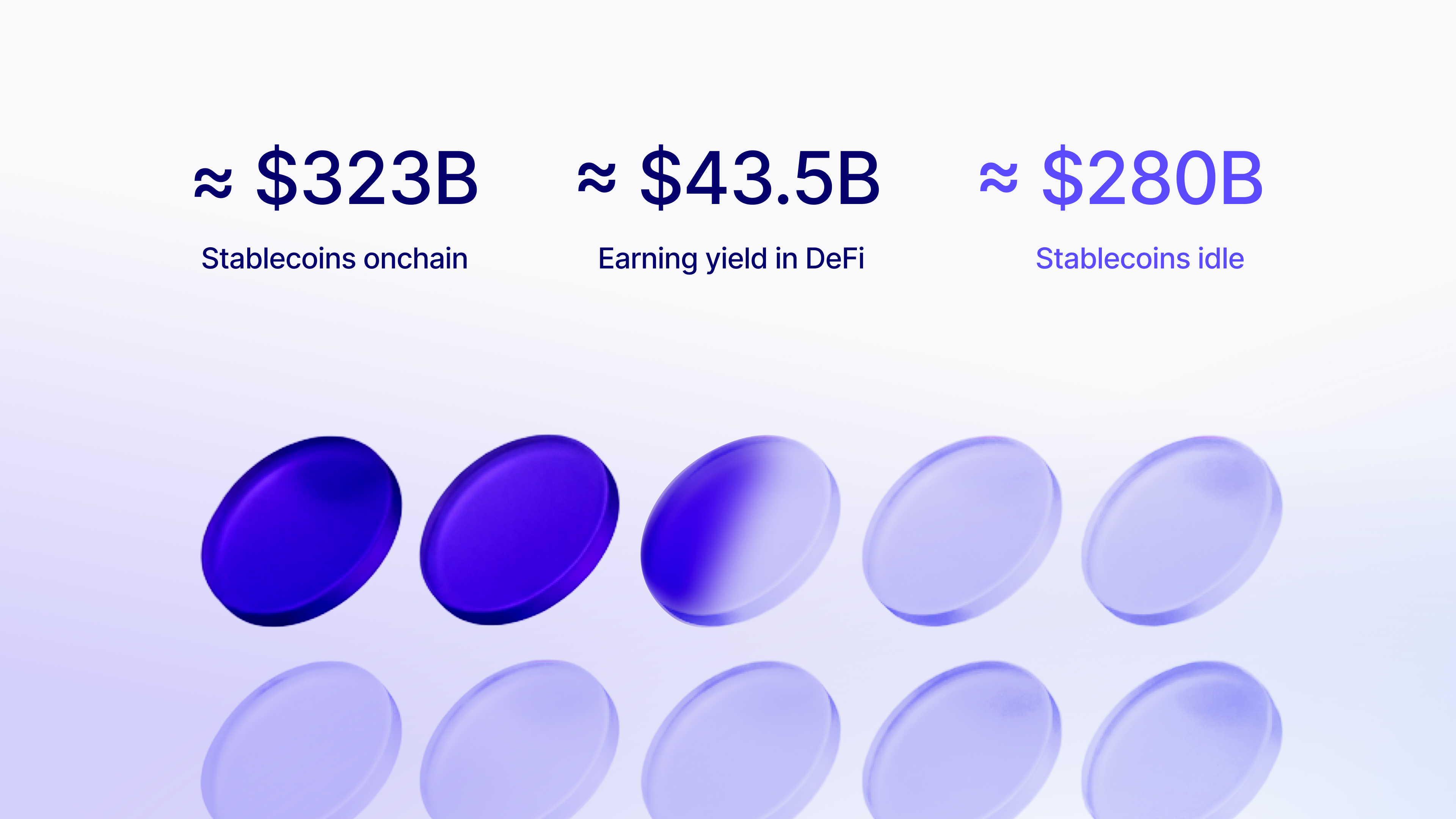
Source: DefiLlama, May 12, 2026
"Idle" carries some nuance. Some of that $280B sits on centralized exchanges earning custodial rewards. Some is held as treasury or runway by businesses and DAOs, and some is in transit between trades. But the majority earns nothing for its holder while issuers earn yield on the underlying reserves.
On a $10K position, the cost of staying idle compounds in two directions. Inflation runs 2–4% in most major economies and far higher in emerging markets where stablecoin adoption is fastest, which means a $10K position loses purchasing power just sitting there. The same position, deployed across vetted high-yield venues cross-chain, earns $400 to $900 a year. The net cost of inertia is 7–12 percentage points annually, or $700 to $1,200 on $10K. Most holders never capture that advantage.
Why the yield gap stays open
Three structural conditions keep stablecoin capital from being deployed. Combined, they’re why $280B has stayed idle.
Yield opportunities are fragmented across chains.
Stablecoin supply is concentrated where on-ramps and liquidity are deepest, still mostly Ethereum. Yield, by contrast, is spread across many chains, many protocols, and many points in the maturity curve. No single chain wins consistently. The picture shifts as new protocols launch, incentive programs come and go, and rates respond to utilization. Capital lives in one place. The most relevant opportunities for any given holder, at any given time, live across many. The market hasn't resolved this through arbitrage because the friction is executional, not informational. Holders know yield exists. The path to capture it is what stops them.
The execution path between chains is full of friction and risk
The manual route from one chain to yield vaults is not for the faint of heart. It usually involves choosing a bridge, paying a fee, waiting for confirmations, funding a destination wallet with gas, and finally depositing into a protocol. Several steps, each a possible failure point, each costing gas, time, or attention. Bridges add a category of risk on top of the friction. Wrapped assets depend on a bridge's continued solvency, and bridge exploits have been one of the largest sources of loss in crypto. Even when a holder is willing to do the work, they're trusting infrastructure that has historically been the most attacked layer in the stack. Most users weigh this risk and complexity, and leave their capital where it is. The alternatives like CEX yield products, wrapped-asset platforms, and custodial lenders work around this by sidestepping the bridge problem entirely and taking custody of the holder's assets instead. One category of risk is traded for another.
Picking and maintaining a position takes expertise and significant attention
The default frame for “best yield” is the highest visible APY. It’s also the wrong frame, and it’s a meaningful reason holders who deploy end up disappointed, exposed, or both.
A 15% APY on a $10K-capacity vault is not the same opportunity as a 6% APY across deep, vetted lending markets. The numbers are comparable, but the opportunities are not.
The headline numbers hide three important things:
- Capacity. Many of the highest-advertised yields collapse the moment real capital arrives. A position sized correctly for a $2M-capacity vault is a different position from one sized for a $500M lending market, and treating them the same is how holders end up watching their APY decay in real time as TVL floods in behind them.
- Sustainability. The advertised APY assumes the rewards retain their advertised value. Often they don’t. Many “high-yield” stablecoin programs pay in the protocol’s own token, priced at current market value. Most depositors only realize that when they sell, into thin liquidity, alongside everyone else doing the same. A 12% APY paid in a token that loses 80% on contact with the market was really 2.4% with vapour. This is worse when the reward token’s main demand comes from the yield program itself, because the “yield” depends on the program continuing to exist.
- Risk profile. A yield is a compensation for risk. Two positions paying the same APY can carry different protocol risk, counterparty exposure, and smart contract surface area. Treating yield as a single comparable number distorts the true risk.
The deeper problem is concentration. Even when a holder identifies a high-quality position, putting all of their capital into a single vault means accepting whatever protocol-level event happens to that vault as a portfolio event. In real terms, you bear the full brunt of potentially catastrophic shocks like exploits, governance failure, or depeg cascade, without any of the mitigation that diversification provides.
A risk-aware position is composed across vetted venues at a tolerance the holder actually chose, not a bet on one vault. The right answer to "where should my stablecoins earn?" is rarely a single venue. The available tools rarely ask the question that way.
And once a position is deployed, it doesn't stay optimal indefinitely. Rates move, protocol conditions change, and capital that was working last month may not be working this month. Most holders don't have a system for selecting an opportunity they can trust, let alone for keeping it tuned. They default to doing nothing.
Existing options, and where they fall short
Stablecoin holders looking for the best stablecoin yield have options. Most settle for rewards on a centralized exchange, a lending position, or a yield-bearing wrapper, and accept the trade-offs that come with each. Every shortcut to stablecoin yield asks the holder to trade something away: custody, asset identity, or an afternoon. None of them offer a risk-appropriate cross-chain yield without giving up self-custody, accepting a wrapped token, or running a second wallet.
What closing the yield gap requires
The $280B figure is a snapshot. The structural condition that produces it is stable. Capital and yield on different chains, an execution path full of risk, and a default frame that rewards chasing the wrong number. It will not resolve through market efficiency alone.
Closing the yield gap requires infrastructure that doesn’t exist yet, a category we’ll call a non-custodial yield routing layer. It does four things at once, collapsed into a single product:
- Non-custodial routing, so closing the yield gap doesn't mean trading one form of inertia for another form of trust. Capital stays in the user’s custody and positions are held directly in the underlying protocols.
- Native cross-chain settlement, so the path from holding to earning isn’t complicated and doesn't run through bridge counterparty risk.
- Risk-aware composition, so a deposit becomes a diversified position at a risk profile the holder chose, not a single bet on a single vault.
- Ongoing position management, so capital stays deployed effectively as conditions move, without requiring the holder to become a full-time operator.
Yieldy is building the sensible default for stablecoin yield: deposit, pick a risk profile, earn capital. The chains, protocols, composition, rebalancing, and the cross-chain plumbing all sit behind a single click. The routing layer is built to be active to follow yield as it moves.

Starting with Ethereum to Solana. Built for everywhere
At initial launch, Yieldy routes USDC from Ethereum to a composed position across vetted Solana venues in one click, via Circle's Cross-Chain-Transfer-Protocol v2 (CCTP). This means burn-and-mint settlement, no wrapped assets, and no bridge counterparty. Capital is deposited directly into the underlying protocols.
Ethereum to Solana is the starting corridor, not the ceiling. Yield opportunities don't respect chain boundaries, asset boundaries, or the line between onchain DeFi and tokenized off-chain yield. The routing layer is built to follow yield across any chain, any stablecoin, and into the broader RWA and tokenization landscape as those rails mature.
Idle stablecoins should be the exception, not the default. We’re building towards that.

Ready to put your stablecoins to work?
Join the waitlist.